The geothermal plant · An upper room
A Library for Small Hands
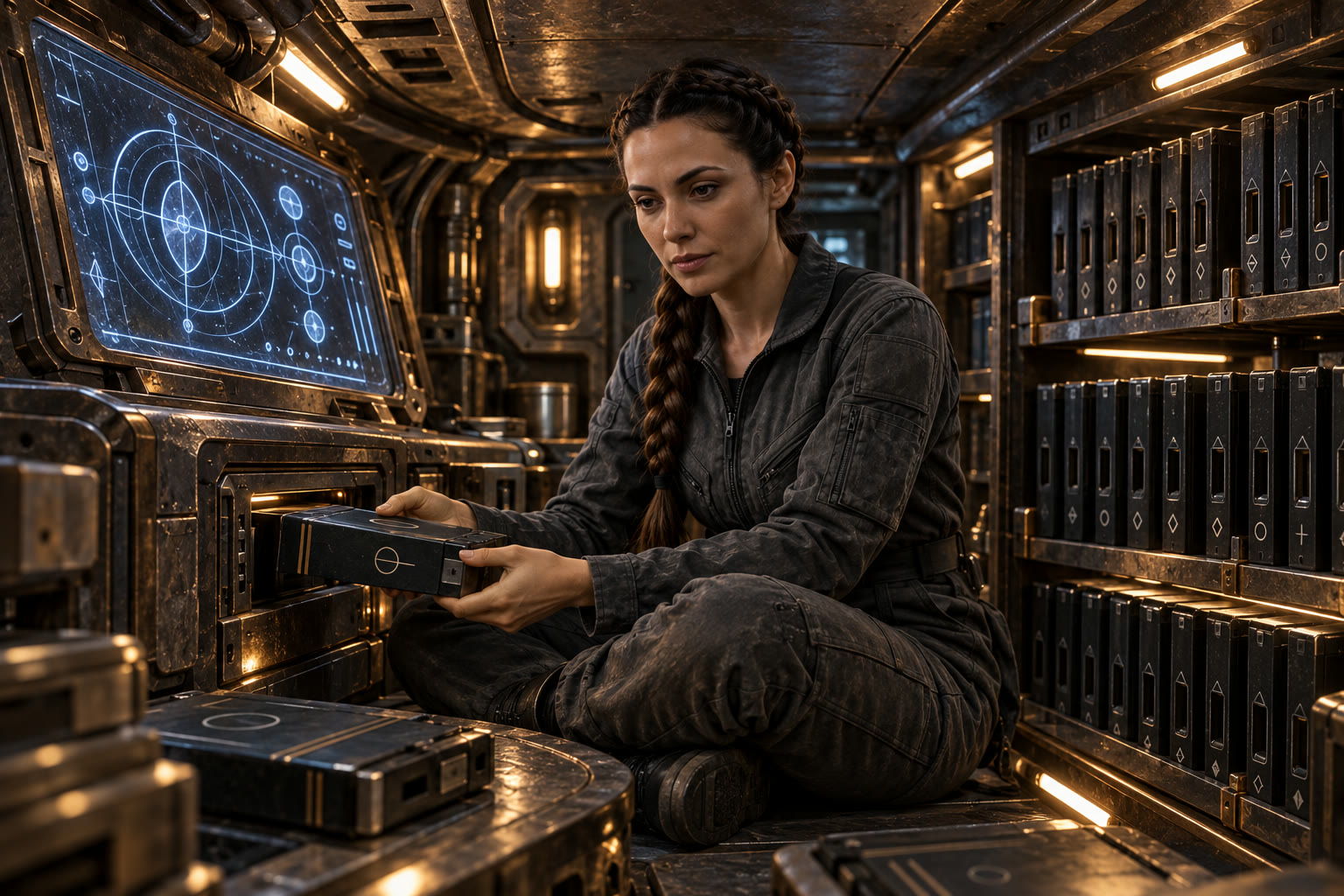
The factory was still working inside the mountain. At the other end of its supply, the geothermal plant offered no comfortable place for a human to stand. Its consoles followed the curve of a room built low to the floor, beneath an access ladder that had waited through their first inspection. Bob was heading back toward the cave with the maintenance kit. Kari stayed to find out what the ladder served.
She pulled herself into the upper space and made room for her body where its builders had expected something smaller. Sitting was possible. Standing was not. A large display faced racks of broad black cartridges, about forty of them, each marked with symbols related to the controls below. Beside the display was a rectangular slot. She had found a reader, and something close enough to a library to begin asking questions.
Recognition came before understanding. The cartridges resembled old recording media; their apparent familiarity supplied no shared language. Her computer could offer English words for the marks, but the words made poor promises. Instructions could sound like threats. A machine part could become an animal. The safer evidence was what the diagrams showed when she selected a tape.
She chose the instruction that seemed to ask for loose teeth to be returned to a wall. A panel opened. Inside were spare fasteners and another example of the tool they had already begun to understand. The accompanying diagram showed how a fitting could release a magnetic rivet. The unsettling title belonged to a practical maintenance procedure.
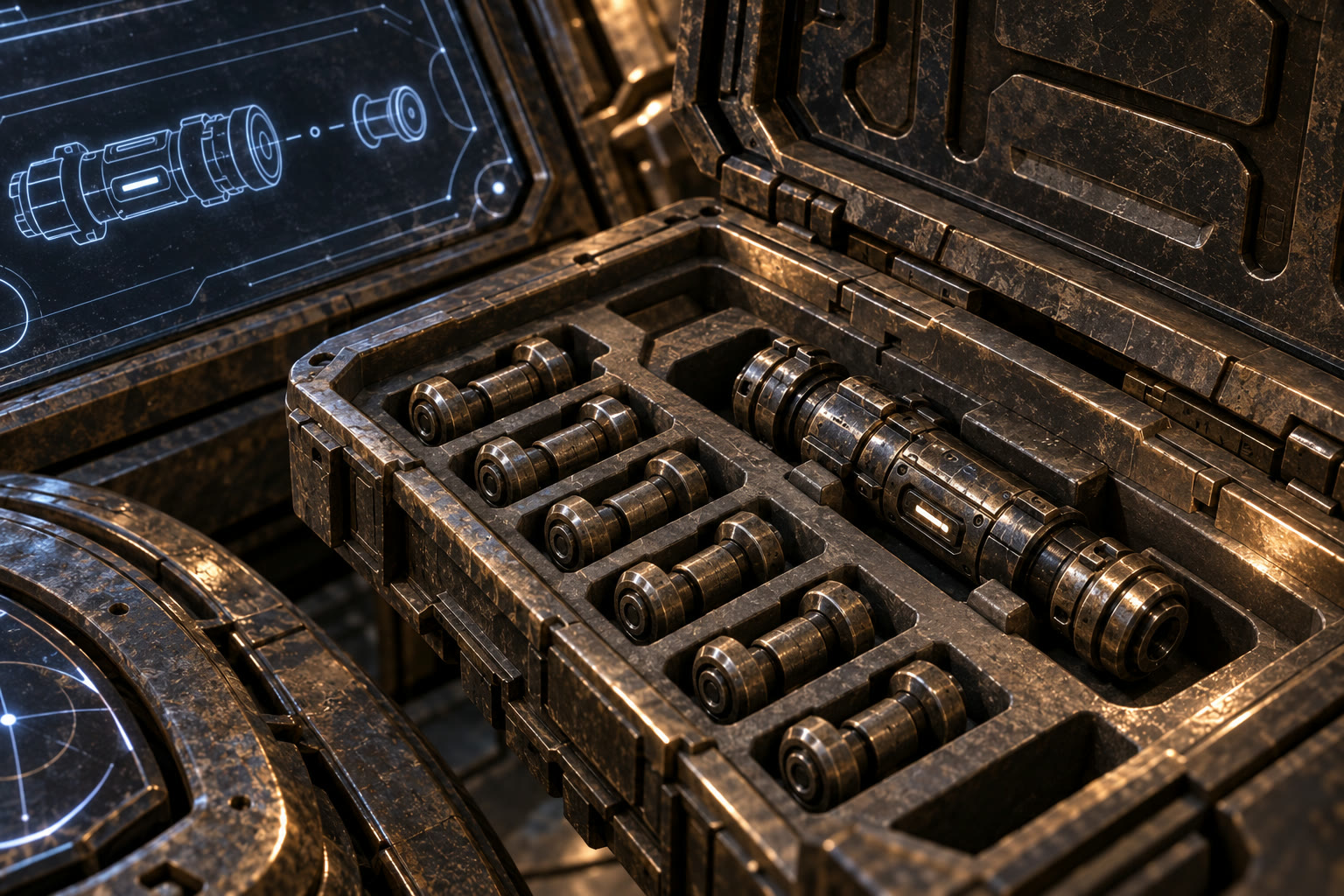
Kari recorded the images and sent them to the others. Their understanding could travel even while they remained in different places: a matching tool, a removable fastener, a shown operation that could be compared with something already held in a hand. None of it made the unreadable sections of the interface disappear. It gave them a way to test one interpretation at a time.
The next cartridge concerned the corridor itself. Its animated diagrams brought the boring machine and the slabs behind it into the same account. In the tunnel, the factory went on advancing by inches while its output accumulated. Up here, Kari kept photographing the instructions. They had discovered a record of work, and the machines below had not finished doing it.
The boring machine · A stopped production line
A Way to Ask
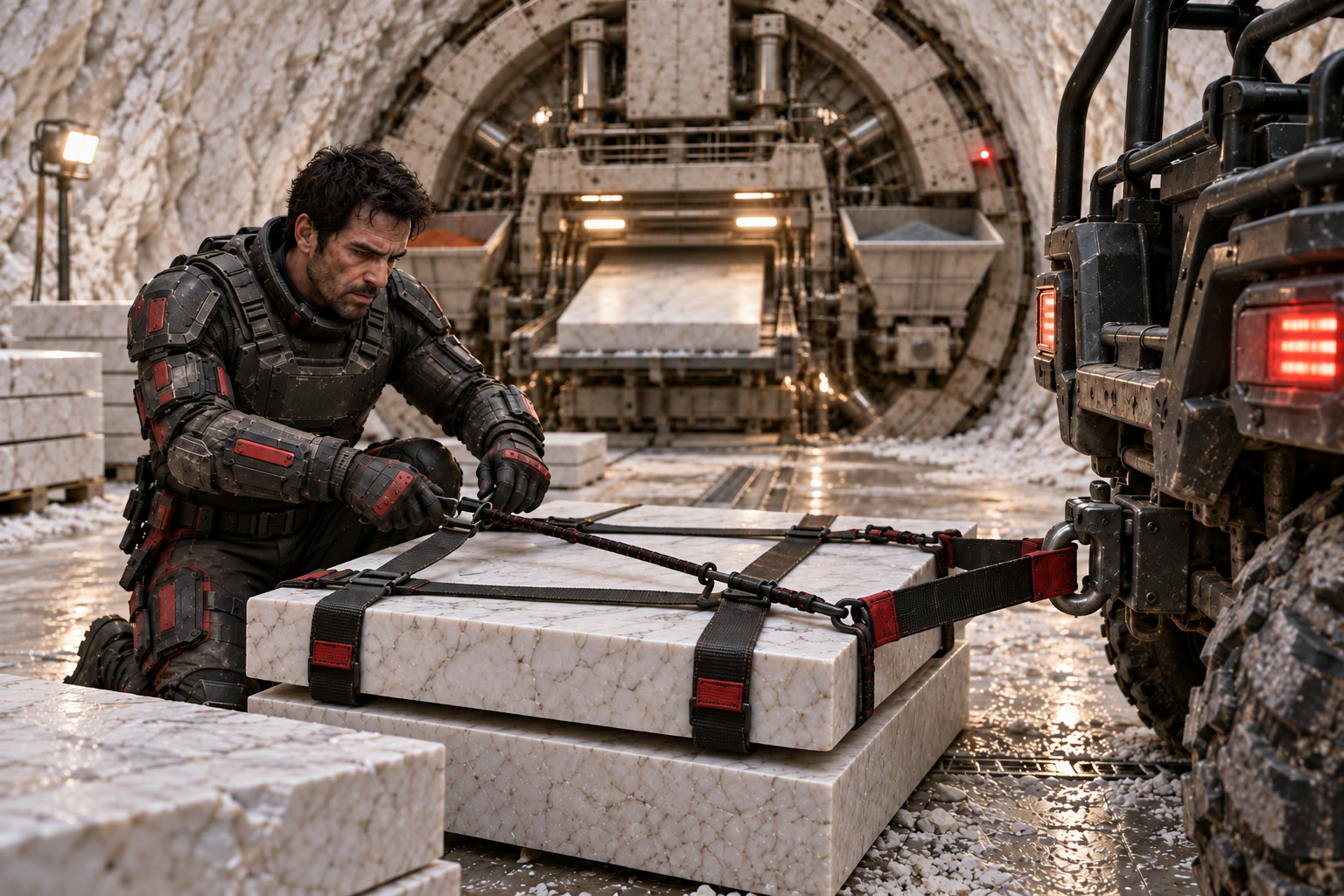
By the time Bob reached the drill, the accumulating slabs had given the machine a problem it could not clear for itself. One plate had come against the edge of another. The stack obstructed the next discharge, and the lights that had been green or yellow were red. Bob hit the emergency stop before trying to move the obstruction.
He brought the survey vehicle down the tunnel without its supplies. Its pulling power offered a way to clear the stack, provided he could make a useful connection to a broad slab. A loose strap thrown over the top would have to do more than survive a single pull. He needed something that could be placed, tightened and used again.
Bob took the webbing that held gear at the vehicle's rear and re-rigged it into a harness. Bungee cords kept it cinched over the slab while he hooked on. The improvised arrangement turned an awkward, flat piece of material into a load the vehicle could pull. It was a solution made from equipment already in hand.
He worked the built-up pile into two stacks of three. When the others arrived in the second survey vehicle, he was unhooking the harness. The machine was moving again, its lights yellow. Clearing the output had restored the process without giving them a fluent explanation of it.
Bob returned to the side panel and connected the portable diagnostic tool. Status indicators, hopper levels and alien menus appeared. A command field could summon a keyboard.
Typing a command he meant as STOP produced a message and no useful change. A question-mark experiment offered no better translation. Bob turned to a menu instead. A selection brought up the pipe arrangement Kari had seen, but this version was alive: dials shifted, material levels changed, and touching a gauge revealed controls.
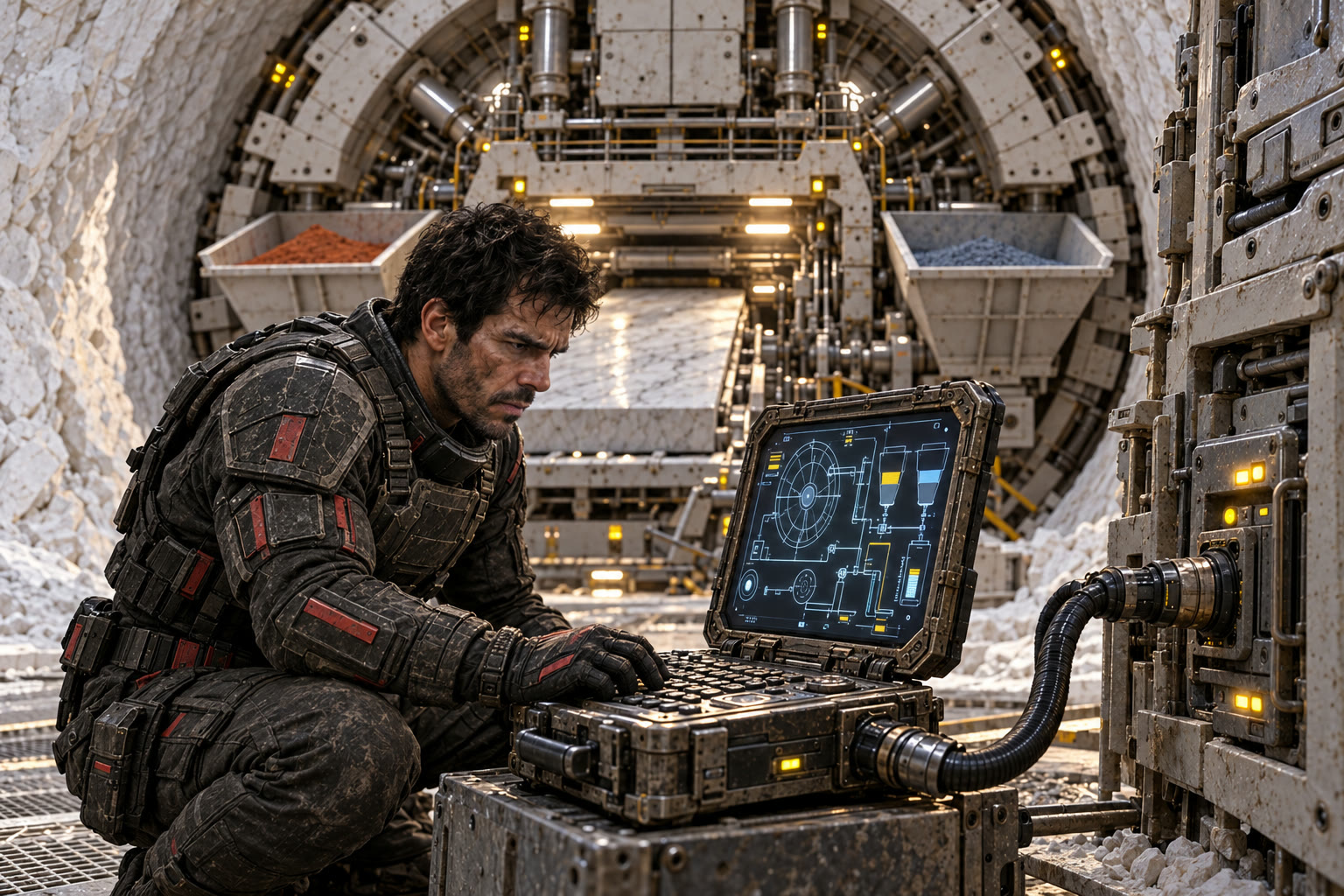
He moved back up through the menu and selected the carrier. The display showed a closed entrance and a little machine behind it. A row of buttons changed an indicator, then opened the door in the image. Nothing opened on the boring machine beside him. He was operating something beyond the panel, somewhere the screen could show and his own eyes could not.
Selecting the carrier brought more controls. Its lamps came on; another view looked forward in infrared. Bob worked out which thumbstick moved the camera and which drove the unit, correcting for an unfamiliar inversion. He chose the downward ramp. Two parked survey vehicles and people appeared ahead. As the little machine approached, the others heard its wheels crossing the floor plates.
The small carrier · An experiment with consequences
A Slab at the Wrong Height
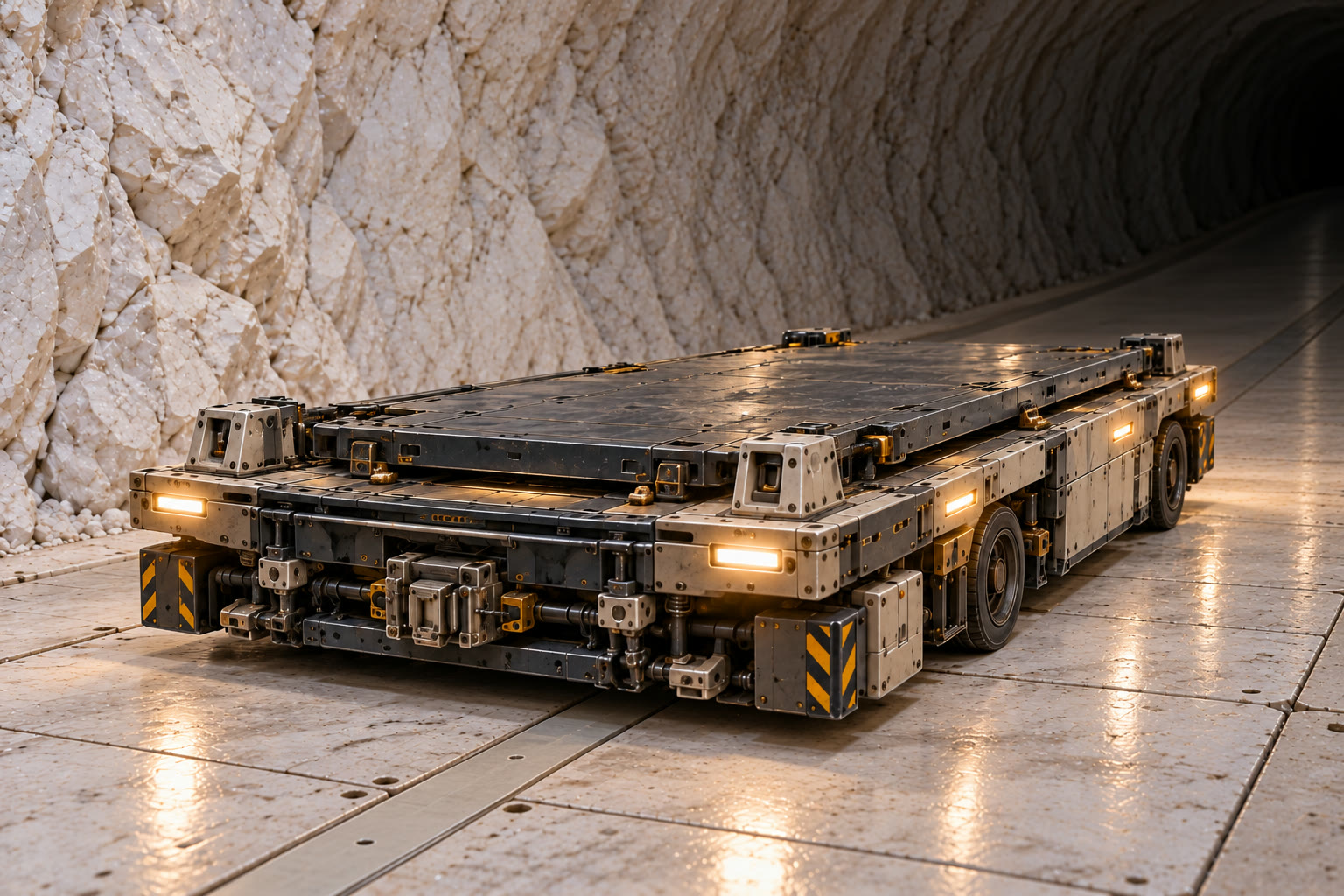
The small machine offered a more immediate kind of question than the tape library. It could be driven close enough to inspect. A corner of a survey vehicle rose near it, and a gun felt lighter. The effects were physical, although the instruments and their owners remained intact. The crew had something they could test without first agreeing on a theory.
A granola bar bounced off without an unusual response. A tossed wrench behaved differently. Near the carrier, its path flattened and it came to rest above the center of the unit. The contrast gave them an observation to work with. It did not tell them what every other material would do.
The controls separated some of the effects. One extinguished a front light and let the wrench drop; switching it back raised the tool again. Another changed the tendency to draw an object toward the center. The display could alternate between ordinary sight and infrared. The crew tested, watched and recorded the distinctions.
Then a loading command brought the nearest slab up. Elias was too close to its path and had to get clear as it passed into position above the carrier. His escape spent some of the luck that had kept the expedition moving. The margin was enough to survive the moment and small enough to change how the space under the slab looked.
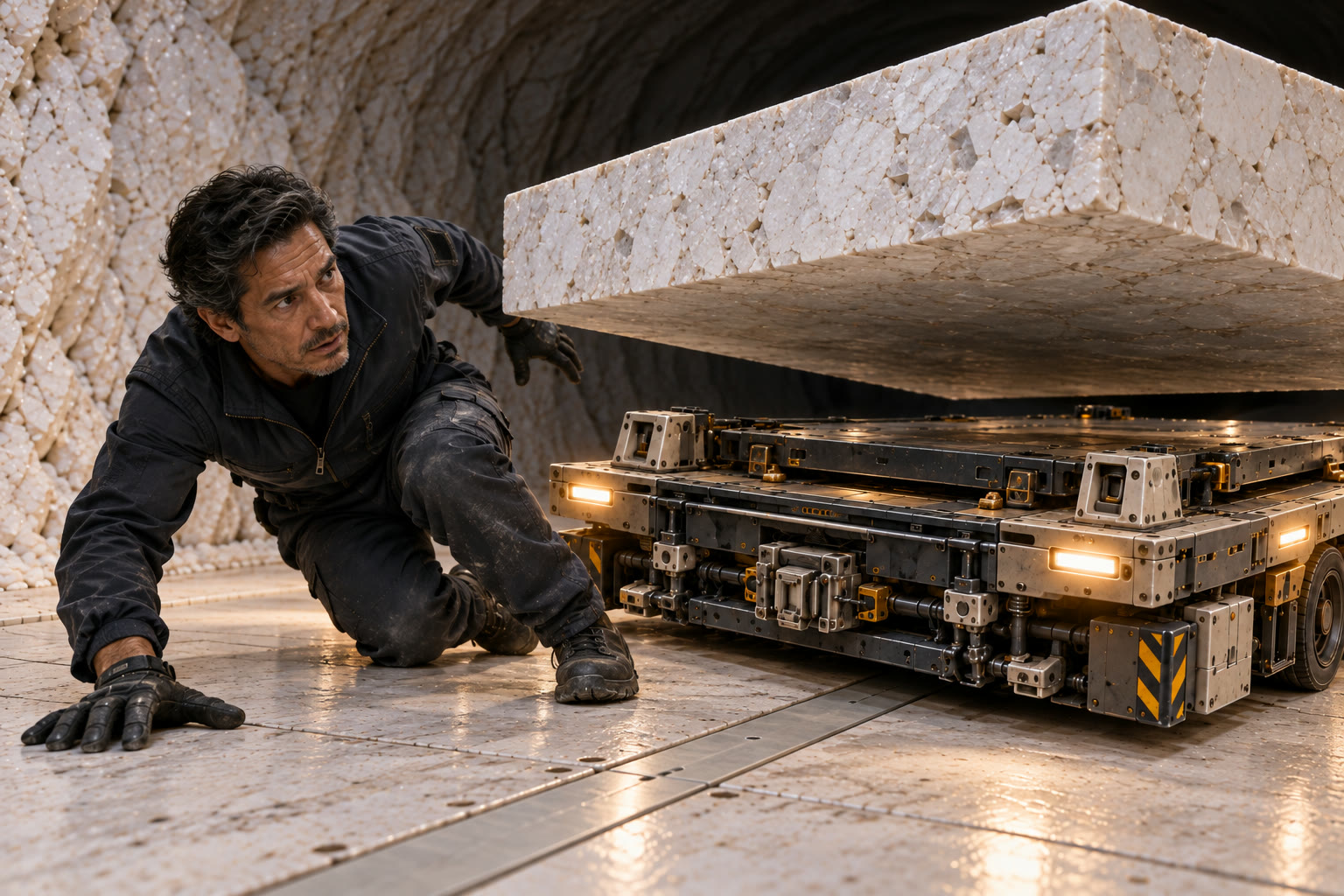
The wrench supplied the next warning. Removing it made the slab shift slightly toward the displaced metal, as if the load were trying to find its center again. A hard shove did not move the slab. Slow pressure could. Those were useful distinctions, learned at close quarters, without making anyone's body a sensible measuring instrument.
The loading control had another action. Pressed again, it unloaded the slab on the same side and dumped it onto the ground. Someone flung clear of the movement. They had found a way to release the load, but the discovery came as another reason to leave room around a working machine.
At the rear they found a pull-out cable with a socket. It extended far enough to reach behind a loaded slab. The portable console now had another place where it might connect. The carrier's functions were becoming clearer one experiment at a time; its relationship to the rest of the tunnel was still a question.
Separate places · A collector on the cliff
A Choice on the Menu
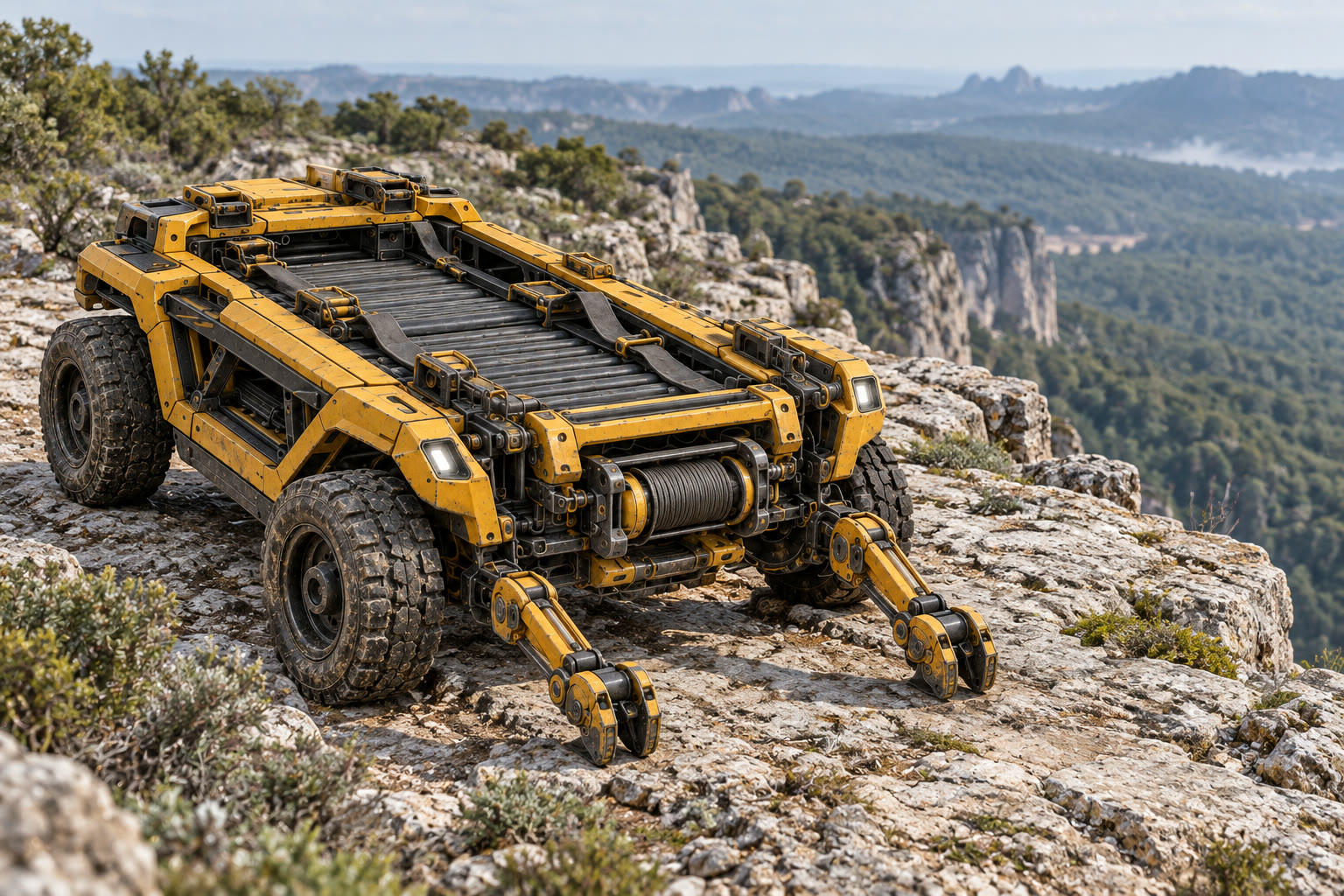
The yellow machine belonged to a different operation. A menu image showed a larger unit with bigger wheels, and another screen offered recognizable local animals among unfamiliar shapes. The crew had pictures and possible names. They had no reliable translation for what selecting an animal would ask the machine to do.
A mustard-dog image and a further icon were selected. The submenu closed, the chosen image glowed and a progress indicator began to fill. The display was reporting a process rather than explaining it. Other work continued while the bar advanced.
At the geothermal plant, a buzzing sound drew attention outside. A look through binoculars found the yellow unit on the cliff top, about the size of a compact pickup. It was separate from the little slab carrier in the tunnel, and large enough that its movement could be followed from a distance.
A hook on a cable shot out and impaled an animal they called a mustard dog. The winch reeled it toward the vehicle. Paired arms moved it under the bed, a conveyor carried it back, and a strap secured the load before the harpoon withdrew. Through the binoculars, the operation was visible. The animal's condition and destination remained out of reach.
Other animal selections could not be triggered while the run continued. The status remained visible, with no obvious further controls. Theories about the machine's purpose ran ahead of what anyone had seen. The collector continued along the top of the hill rather than coming toward the observers.
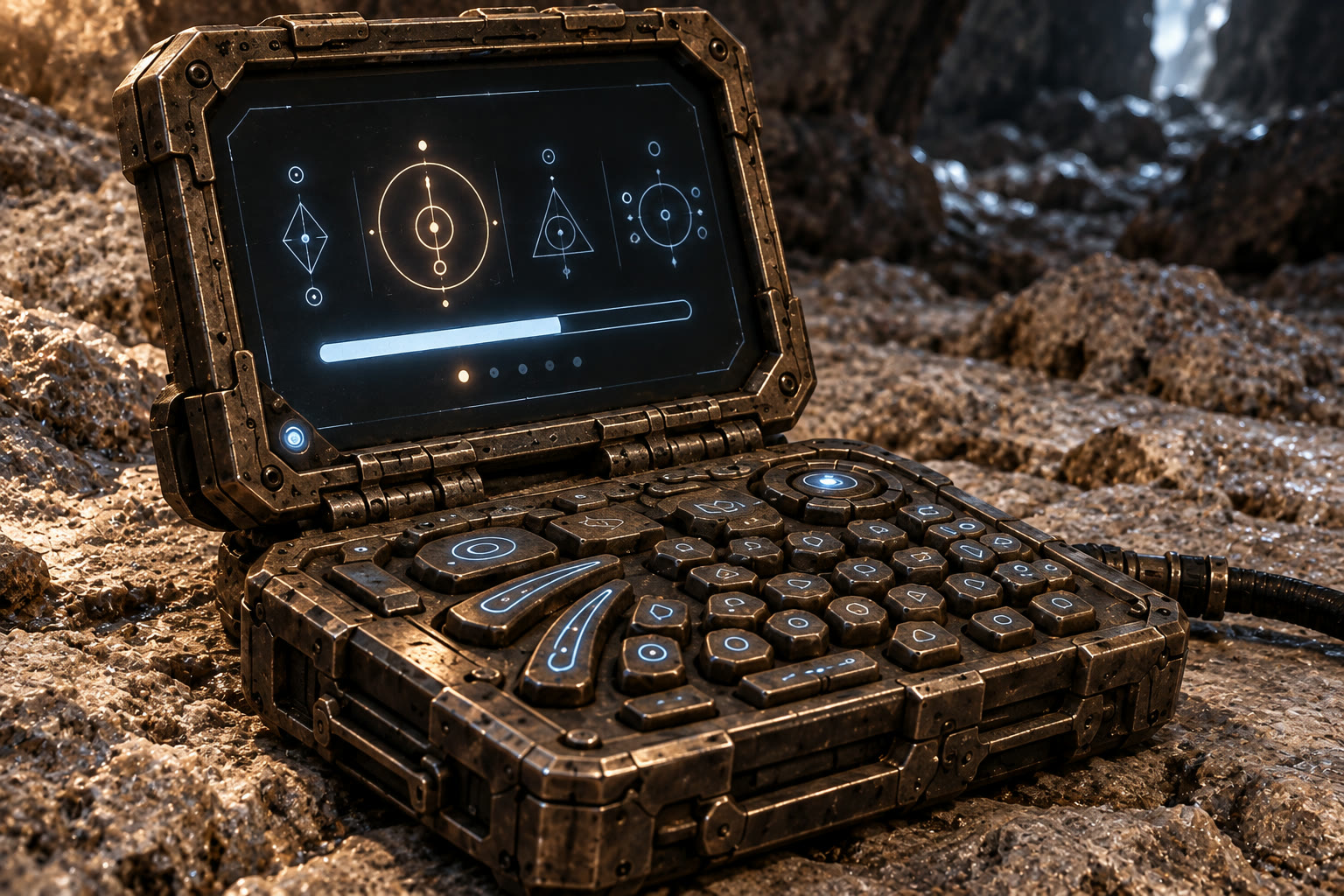
Kari eventually finished her documentation and slept. Morning brought packing: samples went into the available bags and boxes, and the plant-side group headed toward the cave. Attention returned to those waking there and checking the collector's interface. The bar had filled and the screen had returned to its usual menus, without a final message they could reliably read.
A second target selection began another progress bar. It showed that another operation had been requested, not that another animal had been captured. Following the yellow unit offered a different kind of investigation. The question had changed from what a menu meant to where a working machine went.
The return sequence · A transfer point
The Machine's Way Home
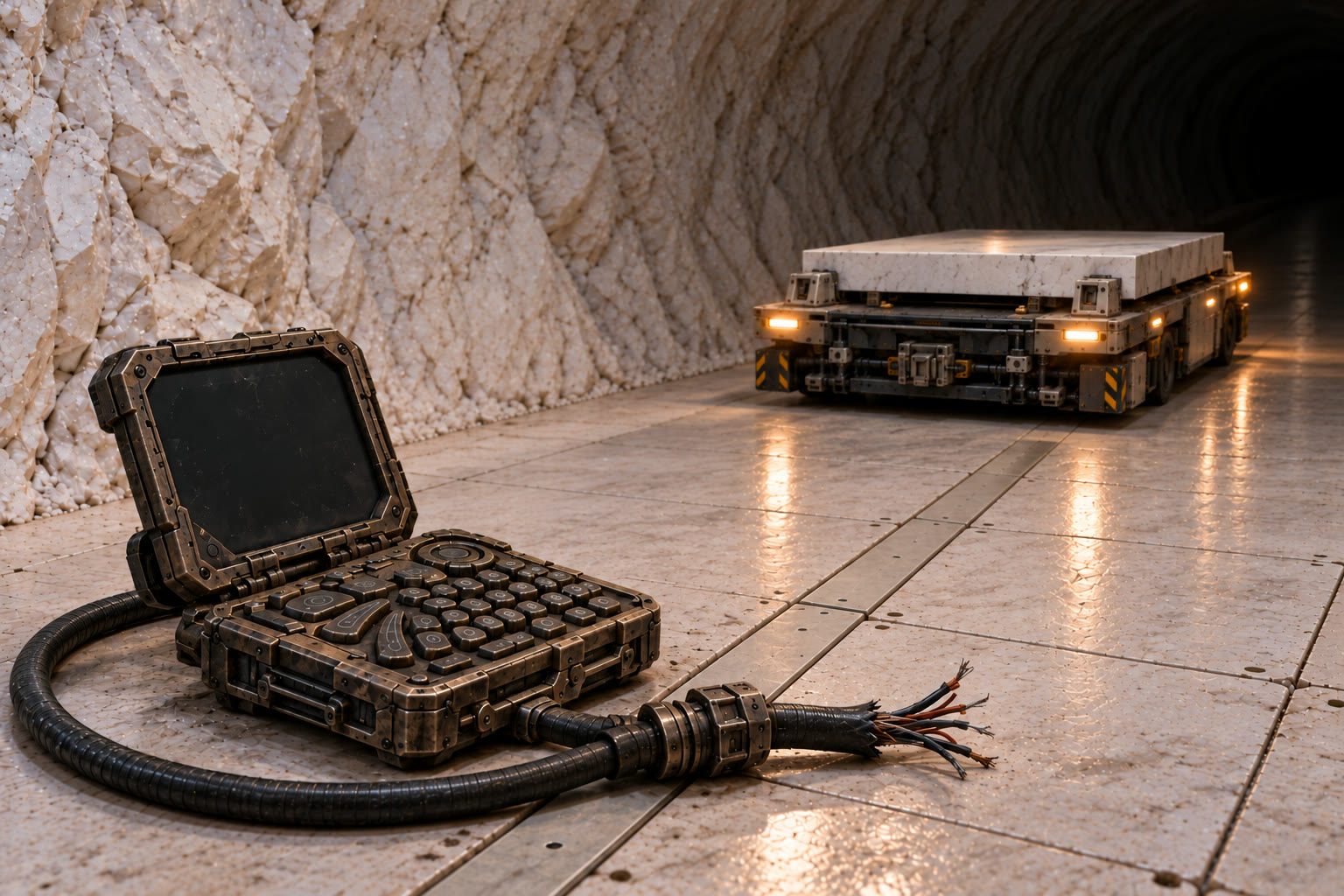
The portable console went dark when disconnected. Connected to the smaller unit's extension cable, it came back with a familiar submenu and an additional blue control. The repeated interface offered a pattern they could recognize even while its writing remained unreadable.
They moved aside before selecting it. Pieces disappeared from a display in a sequence that looked like a countdown. Someone dropped the console and withdrew. The small unit began retracting its umbilical while the connection was still in place.
It turned through a slow circle and swept two red beams across the surroundings. Finding the slab it had discharged, it took the load back and started up the tunnel. The console survived. Its cable did not: cut wires and connector pieces were left behind. The instrument was still available, but its connection would need repair.
A survey vehicle followed at the carrier's slow walking pace. Reaching beneath the moving slab for the trailing connector offered a risk that waiting could avoid. The load would not remain overhead forever. Following the machine could answer a question and provide a safer place to retrieve the pieces.
The route led to an open side entrance and a larger transport parked beyond it. The opening was tall enough for a crouching human, though the taller explorers still had to lower their heads. They watched the little carrier draw alongside the waiting unit.
Gray clamps accepted the slab and held it while the small carrier turned back down the hallway. The larger machine remained in place with yellow indicators. Their different jobs became visible in the transfer itself: one brought a slab, while the other offered room for accumulated loads.
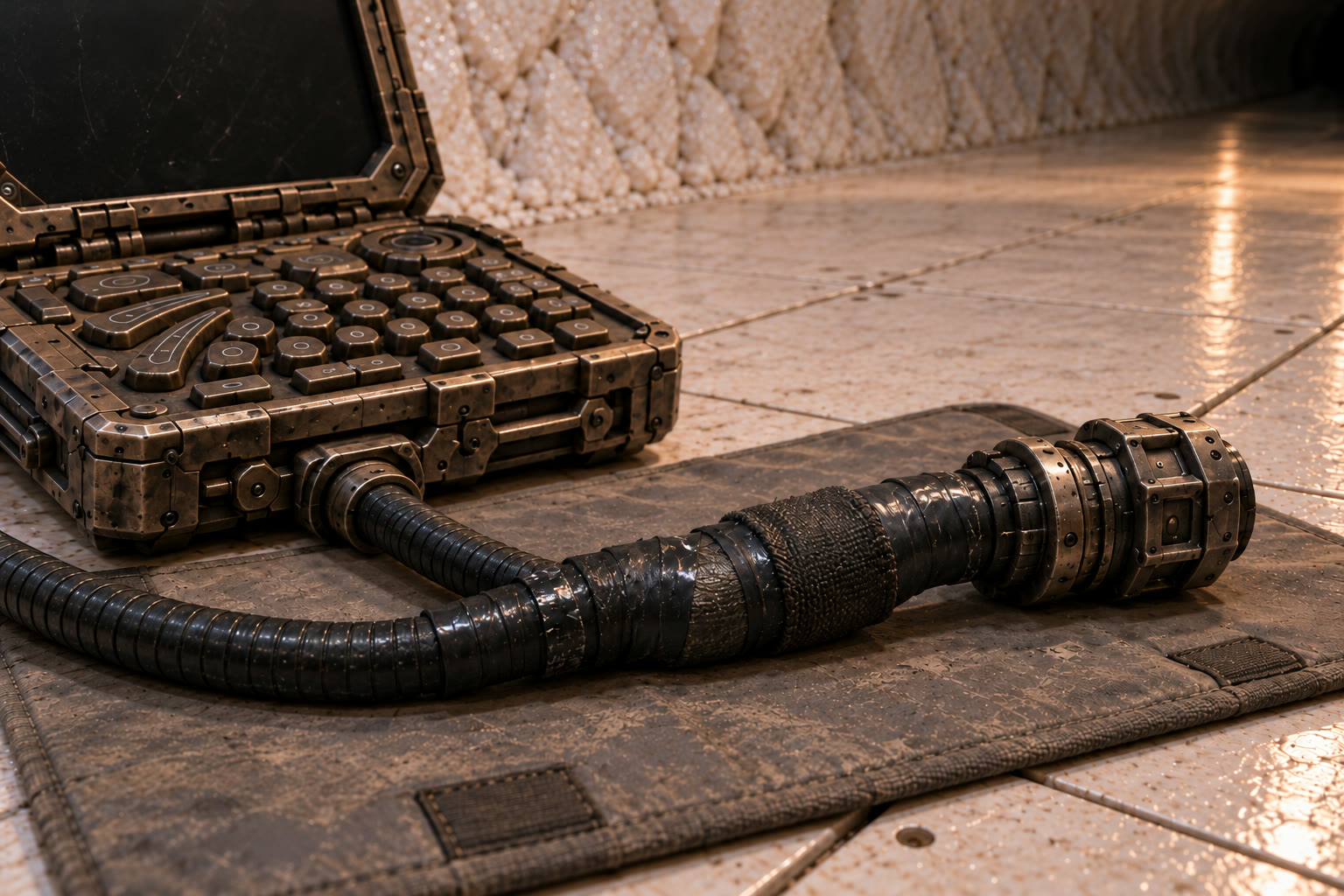
With the slab transferred, the connector could be approached without the same overhead threat. Bob repaired the damaged cable in less than an hour, leaving a bulky but usable splice. The console had its connection back.
A magnetic cover on the larger unit exposed a matching port. Connected there, the repaired console showed a carried slab and room for more. The crew had followed an operating process to its next stage. Beyond the waiting transport, the passage continued in darkness.
Beyond the transport · The work that waited
Three Miles of Dark
They divided the work again. The cave mouth offered room to fly drones and another chance to discover where the yellow collector went. Kari was at base camp. A smaller group continued beyond the transport, carrying its own light.
The larger machine blocked the passage. The survey vehicles could not simply be driven past it; continuing meant going on foot and climbing around the obstruction. The walkers took the dark corridor. One tried to move quietly, while the others' footsteps made their company plain.
Outside, the yellow collector emerged into the field and a drone was sent to shadow it. Underground, about three miles of passage brought the walkers to a closed door. Above and below the rock, the separated groups each had their own work in front of them.
The door presented a familiar kind of problem: a panel that could be lifted and a magnetic point behind it. A magnetic boot supplied the release. The door opened quickly. Lights came on behind the explorers and continued overhead into the space beyond.
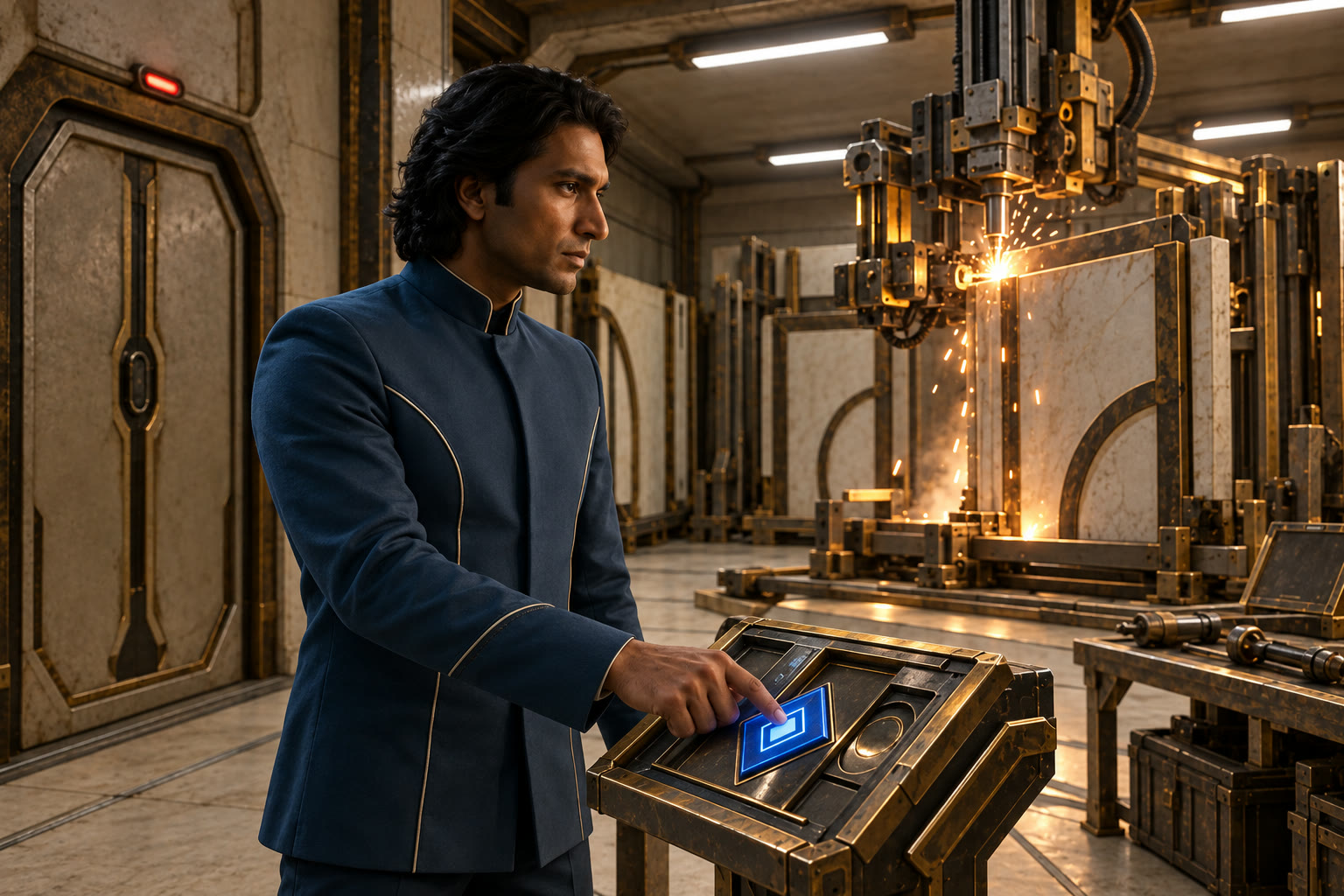
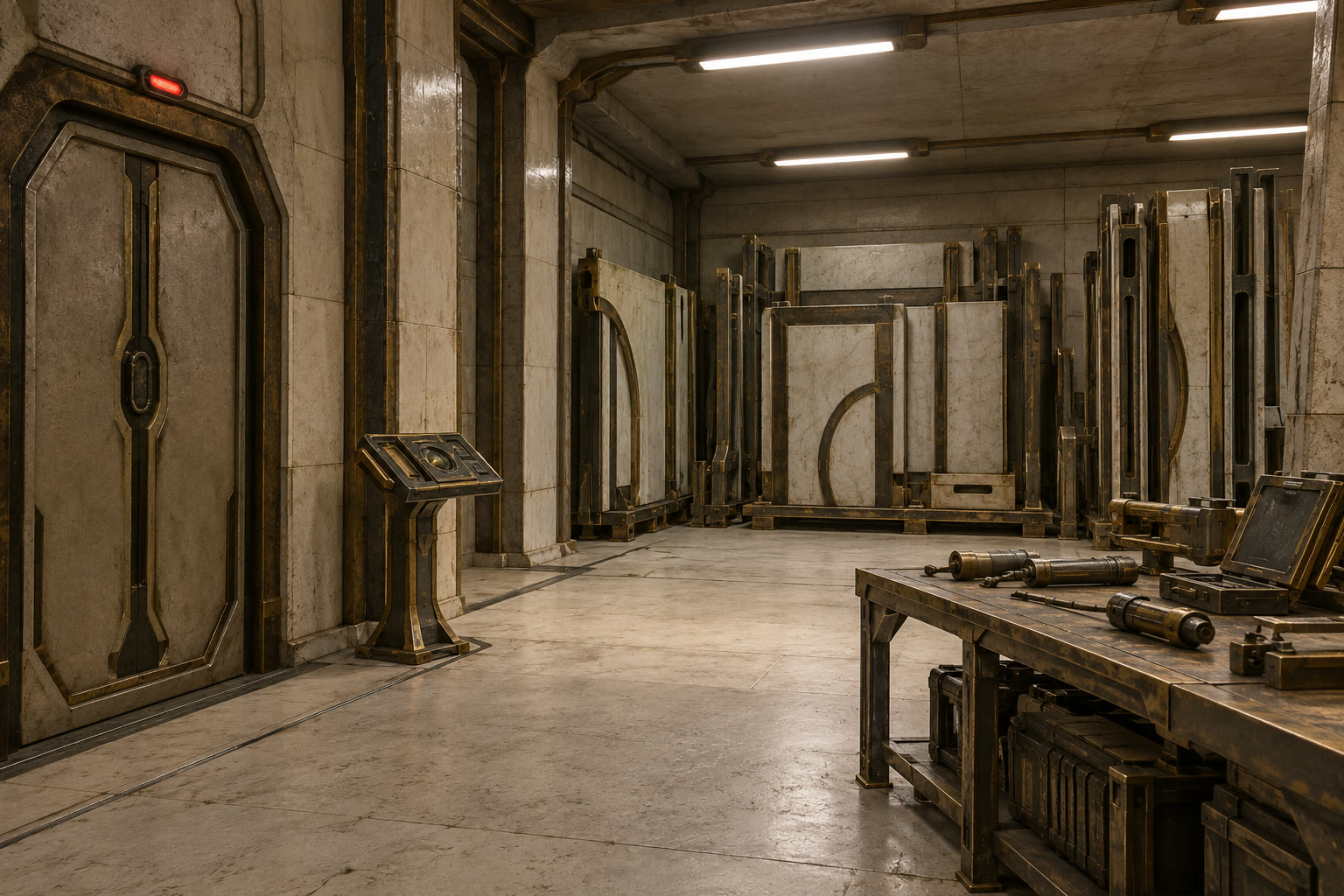
There was room for a cart to pull aside and another to be accommodated. A door stood on the left beneath a red light. A console waited on a stand, with a workbench nearby. Farther shapes that first suggested offices resolved into sections and panels already assembled. The crew had come to a place that made parts of buildings.
The workbench held magnetic and extrusion tools. Another portable panel resembled the one recovered from the geothermal plant. The repeated controls offered a way forward without making the writing readable. A yellow mark could be recognized, and the blue shape recalled other machines taking up their work.
Bob was with Victor when the commander selected the blue control. One of the explorers stepped back. Machinery moved, and welding began. That was where the session stopped: with the workshop alive around them, and its work beginning to answer the question the tunnel had brought them to ask.